


Every few months, another state rewrites the compliance rulebook, and every time, lenders scramble to adjust. The new Equipment Finance News report lays it bare: state-by-state differences in commercial equipment financing laws are a strategic fault line dividing lenders who adapt from those who risk falling behind.
Proactive equipment lenders are asking whether they can truly scale by reacting to every regulatory change, or whether they need compliance operations that adapt faster and more consistently.
Complacency is the Risk You Can Control
Every commercial lender knows the frustration of trying to make one contract work in multiple states. What passes easily in one state can raise red flags in another. And “right to cure” and repossession notice requirements can differ materially by state.
As EFN rightly points out, lenders are facing “variation fatigue” on every front. The pace of state-level change would strain any team, especially those juggling high-volume deal flow and lean compliance resources. What’s encouraging, however, is that some lenders are finding real relief by rethinking how compliance fits into their process.
At GoDocs, we’ve seen that shift firsthand. One multi-state customer, First Mid Bank and Trust, told us, “GoDocs has dramatically improved our compliance confidence, especially in states with complex lending laws. Their platform enabled us to launch in a new market in just eight weeks with minimal training and full compliance automation.” That’s more than an efficiency gain, it’s a powerful example of how the right technology can turn compliance from a barrier into a bridge for growth.
The Wrong Lesson from the CFPB Pullback
Much has been made about evolving Consumer Financial Protection Bureau enforcement priorities, as the EFN piece notes. But less oversight doesn’t mean less exposure. In fact, reduced federal clarity can contribute to widely varied state interpretations of similar rule sets. That uncertainty is increasingly being addressed at the state level, including through laws that extend consumer-style protections into parts of the commercial space.
That’s what makes today’s compliance risk so dangerous: there’s often no single referee, just a patchwork of state-level judgment calls. When states can shift requirements on short notice, waiting to adapt until the next audit or lawsuit is exceptionally risky.
TL;DR: Automation Is Essential for Multi‑State Compliance and Growth
Equipment Finance News highlights an important shift: more lenders are turning to automation, large‑language‑model tools, and compliance software to help flag potential issues earlier, before they become liabilities—with appropriate human oversight. According to data shared from Alloy, 94% of fintech‑partnered banks believe investing in new compliance technology and training is critical.
Used wisely, these technologies free legal and operations teams to focus where human judgment matters most.
Read more on compliant use of AI in commercial lending.
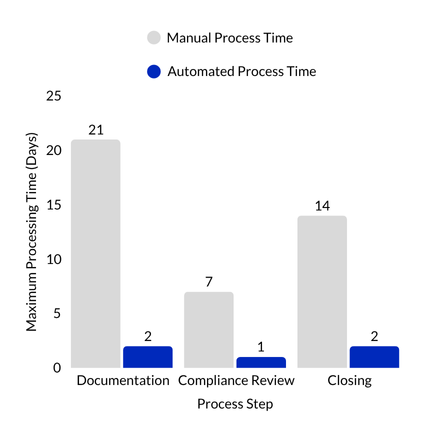
The most effective commercial equipment lenders are not waiting for the next rule change. They are using automation to make compliance collaborative, scalable, and measurable — and they’re seeing real results:
- TheLender reported growing loan volume by 10x with GoDocs and continues to expand without adding staff.
- A leading West Coast Credit Union leveraged GoDocs’ compliance framework to expand lending into 20+ states with confidence.
- Asset Based Lending scaled operations while holding costs steadily using GoDocs automation.
Equipment Lenders Who Redesign Compliance for Automation Will Thrive
The lenders that will thrive through this next wave of state-by-state reform are those who build proactive compliance architecture; systems that help identify changes early before they create avoidable risk.
At GoDocs, we often say automation isn’t about moving faster; it’s about moving smarter. That means continuous legal oversight (from our in-house attorneys who monitor relevant law changes and update document logic and content accordingly), and dynamic document assembly to help align clauses with the deal, the jurisdiction, and applicable requirements as they evolve.
The maze of state variation isn’t shrinking. But the lenders who automate it and operationalize it will stop seeing compliance as a drag and start seeing it as a differentiator.
Chief Legal Officer